PITTSBURGH NEIGHBORHOODS: NARROWING DOWN YOUR SEARCH

Updated: Sep 28

Pittsburgh geography feels confusing because it actually is
Pittsburgh is not a flat, gridded city where every neighborhood blends neatly into the next. It is a city of rivers, hills, bridges, tunnels, old mill towns, tight residential streets, and more municipal boundaries than most newcomers expect.
That is part of its charm. It is also why buying here without a local Pittsburgh realtor, particularly a Pittsburgh relocation realtor can get expensive fast.
The first thing to know is this: Pittsburgh is both a city and a mailing address. Those are not always the same thing.
A home can have “Pittsburgh, PA” in the address and still be outside the City of Pittsburgh. It might be in a borough or township within Allegheny County. That affects taxes, services, school district, parking rules, rental rules, and sometimes eligibility for certain city-based school options.
So when someone says, “I live in Pittsburgh,” your next question should be:
“Do you mean the City of Pittsburgh, or the Pittsburgh area?”
That one question can change everything.
The rivers and tunnels shape daily life
On a map, two neighborhoods might look close. In real life, a river crossing, hillside road, tunnel, or bridge backup can make the trip feel very different.
This is why locals talk so much about avoiding certain commutes. It is not snobbery. It is survival.
A few examples:
Living south of the city can be beautiful and convenient, but some routes into Downtown rely on tunnels.
Living north can give you more space and strong suburban options, but your commute may depend on bridges and highway timing.
Living east can put you near universities, hospitals, parks, and city neighborhoods, but traffic patterns vary street by street.
Living in the hills can mean incredible views, but winter roads and parking deserve real attention.
A Pittsburgh commute is not only about miles. It is about terrain.
Start with lifestyle before you start with listings
It is easy to fall in love with a Pittsburgh house online. The city has gorgeous old homes, big porches, stained glass, pocket doors, fireplaces, and brick streets. Compared with many other metros, the prices can still feel refreshing.
But the house is only one piece.
Before choosing a neighborhood, get honest about how you will live day to day.
Ask yourself:
Do you need to commute Downtown, Oakland, Lawrenceville, the Strip District, or a hospital system?
Do you want to walk to coffee, restaurants, and parks?
Do you need off-street parking?
Are schools part of the decision?
Do you want a yard, or would you rather have city access?
Are you comfortable with hills, steps, and older homes?
Will this be a primary home, rental, house hack, or long-term investment?
A simple guide to Pittsburgh areas
No short guide can explain every corner of the city. Pittsburgh has many neighborhoods, and the metro area has even more boroughs and suburbs with their own personalities.
Still, most newcomers start by trying to understand the larger sections of town. Here is a practical way to think about them.
Area | General feel | Good questions to ask |
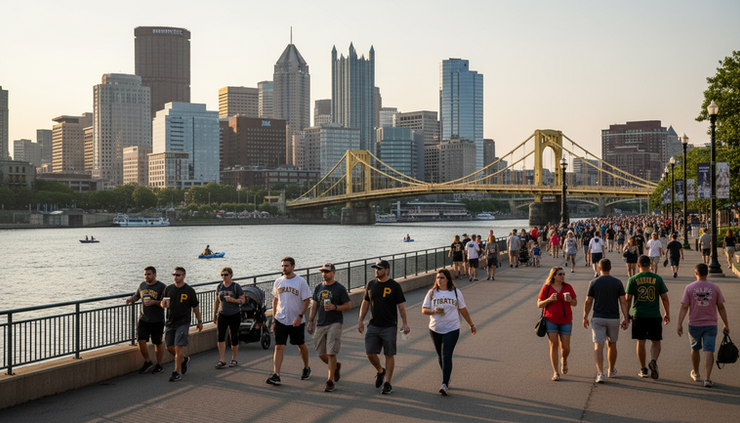
North Side and North Shore | Historic homes, stadium access, riverfront trails, city energy, pockets that vary block by block | Am I in the exact neighborhood I think I am? What is the block like at different times of day? |
East End | City neighborhoods near parks, universities, hospitals, restaurants, and cultural amenities | How close do I want to be to Oakland, Shadyside, Squirrel Hill, Highland Park, or Regent Square? |
South Side and South Hills | Slopes, views, nightlife in parts, residential pockets, suburban options farther out | Will my commute involve a tunnel? Is parking practical? |
North Hills | More suburban space, shopping, highways, and many school district choices | How often will I need to cross a bridge or commute Downtown? |
West End and airport corridor | Access toward the airport, river towns, and more varied price points | Is my priority city access, airport access, or long-term investment? |
Nearby river towns | Older housing stock, main streets, and potential value plays | What is the local rental demand and what reinvestment is happening nearby? |
This is not a ranking. It is a starting point.
Pittsburgh is hyperlocal. One street can feel completely different from the next. That is why investors and relocating buyers need more than a list of “best neighborhoods.” They need context.
Neighborhood names can be misleading
One thing that surprised me early on was how loosely people use neighborhood names.
A listing might mention a nearby popular area because it sounds familiar. A rental ad might stretch the boundary. A local may describe an area by an old name, while a map uses another one. Some places have official neighborhood names, informal names, and school district labels all overlapping.
That is why I tell people to slow down and check the basics:
Search the exact address on a map.
Look up the municipality.
Confirm the school district.
Drive the block if possible.
Visit during the day and evening.
Check how you would actually get to work, school, groceries, and childcare.
Look at nearby vacant lots, renovations, commercial corridors, and major roads.
Online research is useful. In Pittsburgh, it is not enough.
A historic home may photograph beautifully and still sit on a block that does not fit your comfort level. Another house may look modest online and sit in an area seeing steady reinvestment. You need eyes on the ground.

So where should you live in Pittsburgh
The honest answer is that the right neighborhood depends on your daily life, not someone else’s top-ten list.
If you want walkability, restaurants, parks, and city energy, start by studying city neighborhoods and East End options.
If you want more space, a yard, and suburban schools, look closely at the North Hills, South Hills, and surrounding boroughs, while paying attention to commute routes.
If you want investment potential, focus less on the cheapest house and more on rent demand, local development, property condition, and your exit strategy.
If you want Pittsburgh Public Schools options, confirm that the property is actually inside the City of Pittsburgh.
If you hate tunnel traffic, do not ignore that feeling. Build your search around the commute you can live with.
Most of all, give yourself permission to be confused at first. Nearly everyone is. Pittsburgh does not reveal itself all at once. It unfolds neighborhood by neighborhood, bridge by bridge, staircase by staircase.
Start with the map. Then study the boundaries. Then walk the blocks. The right Pittsburgh neighborhood is not just the one with the prettiest house. It is the one that fits your life, your budget, and your future plans.
As always if you need a Pittsburgh Realtor or Relocation Specialist, please feel free to email me, Jessica Rutamu Compass RE as Jessica.Rutamu@compass.com


Comments